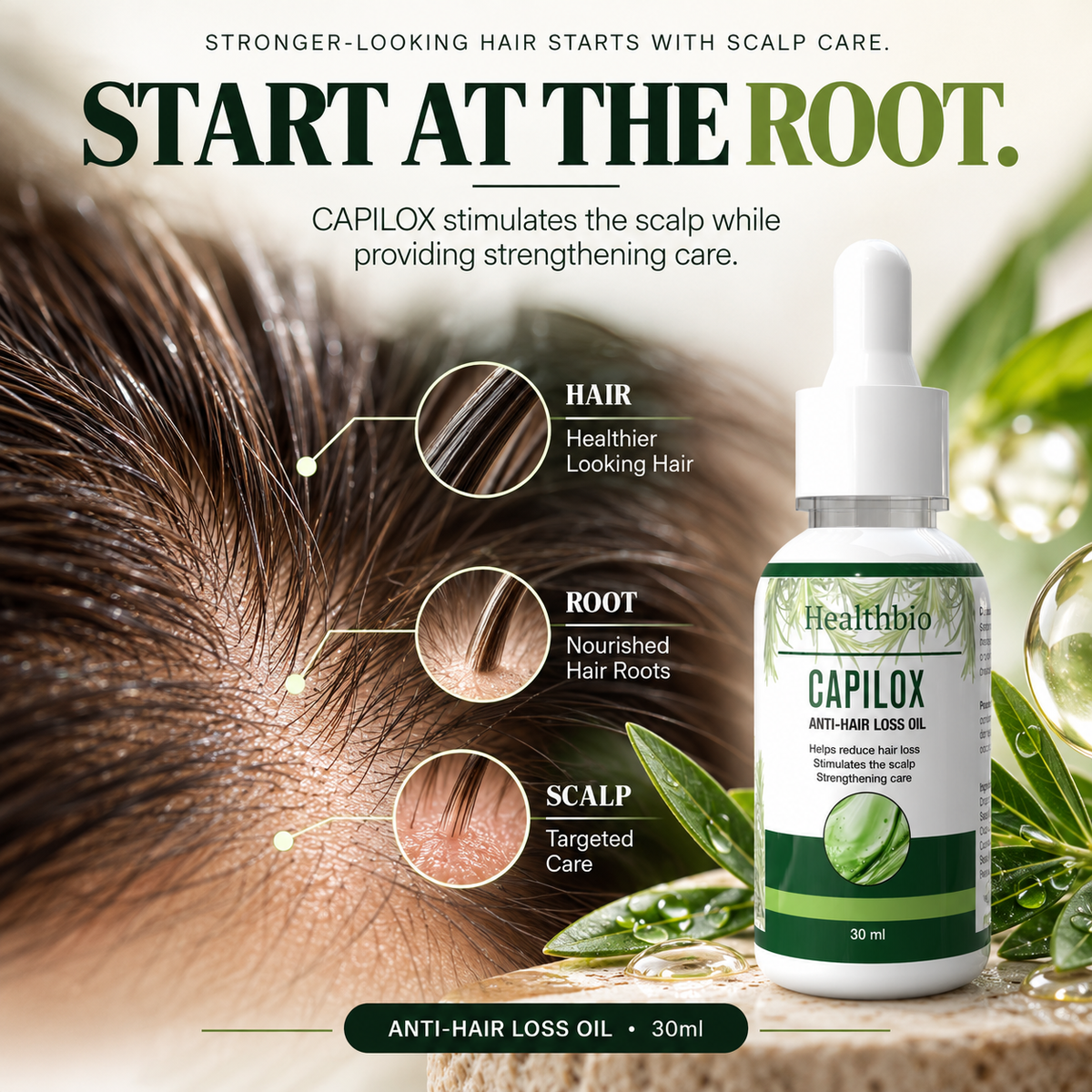
Sixty seconds on the only part of your hair that’s actually alive.
Photograph your parting in the same light on day one. Use it three or four times a week for three to four months. If nothing has changed, tell us and we’ll refund it — bottles used.
“I look after my hair.”
Everything you can see is already dead.
Once a hair clears the surface it has no blood supply, no cells doing anything, no capacity to repair. Conditioner can coat it and smooth it. Nothing can heal it.
Every hair is built in a follicle sitting in the skin of your scalp. That follicle is living tissue with its own blood supply — and it’s the only place a better hair can come from.
Most people run a five-step routine on their face and give the skin under their hair detergent twice a week. It’s the only skin on the body treated that way.
Masks, serums, bond builders — all working on the part that can’t change, while the part that decides what grows next is still being ignored.
This is a 30ml bottle with a dropper because it was built for the scalp, not for the lengths. That’s the entire design brief.
You cannot improve a hair that already exists. You can only build a better one next time.
Why this goes on your skin, not your endsA shampoo is rinsed away before it has finished arriving. That isn’t a criticism of shampoo — it’s the definition of one. Everything that needs time has to be left on.

The dropper puts the oil onto the scalp along a parting rather than through the lengths, so almost none of it is wasted on hair that can’t use it. Then it stays there — hours, or overnight — instead of going down the drain.
That difference in contact time is the whole reason this and the shampoo are two separate products rather than one. The wash prepares. This is the part that gets to work.
Roughly what sits in the skin of an average scalp. Each one is a small living factory, and not one of them is on the part of your hair you can see.
The massage. Not a flourish at the end of the instructions — a genuine part of why the routine works, and the reason the ritual matters more than the volume.
Before a fair verdict. Hair grows roughly a centimetre a month and the cycle is slow. Anything judged sooner than this is judged on feel, not on fact.
A minute of proper scalp massage is one of the few hair habits with genuine work behind it — and it costs nothing. We’d be a strange company to hide that, so we’ve built the product around it instead.
You could do the massage with nothing on your hands and it would still be worth doing. What the oil adds is a reason to show up, somewhere for the minute to live in your evening, and targeted care sitting on the scalp while you do it.
On the shampoo’s own page we say that if you’re only buying one of the two, buy the oil. That hasn’t changed on this side of the fence. Contact time is the thing that separates them, and this is the one that has it.
Together they work better — a scalp cleared of build-up is a scalp an oil can actually reach. But the order of importance is not a close call, and we’re not going to pretend it is to sell a second bottle.
Optional. The oil is the half that matters most.


On dry or towel-dried hair, make a clean parting so you can see the scalp. Then another, a couple of centimetres along. Sections, not a general splash over the top.

A few drops along each parting, straight onto the scalp. Not through the lengths — they can’t use it, and that’s where a small bottle gets wasted.

Fingertips, firm enough to move the scalp. Leave it on — a few hours, or overnight. Three or four evenings a week is where most people land.
Same light, same place, hair parted the same way. Density changes far too slowly to see in a mirror you look at every morning — and a photo from four months ago is the only way to settle the argument honestly, in either direction.
Four things people reach for. If your thinning is genetic, the strongest column here is not ours — and you should know that before you spend anything.
| Capilox scalp oil |
Anti-hair loss shampoo |
Pharmacy regrowth treatment |
Hair supplements |
|
|---|---|---|---|---|
| Time spent on the scalp | Hours | ~90 seconds | Hours | N/A |
| Targets the scalp rather than the lengths | Yes | Partly | Yes | Indirectly |
| Builds in the scalp massage | Yes | Briefly | No | No |
| Strength against genetic thinning | Supportive | Supportive only | Strongest | Supportive |
| Leaves the hair feeling oily until washed | Yes — it’s an oil | No | Sometimes | No |
| Needs a pharmacist or doctor | No | No | Worth asking | No |
A receding hairline or a part that keeps widening is a pattern worth showing a pharmacist or doctor. Use this alongside what they recommend — not instead of it.
Four months on, the photographs look the same. You tell us and we refund it. You’ll have spent sixty seconds an evening on a habit that costs nothing to keep, and you’ll know your thinning needs a different conversation — which is worth more than another year of guessing.
Somewhere in month three you notice short new hairs standing up along your part. The scalp stops feeling tight and flaky. The photograph from day one looks like somebody else’s head — and the sixty seconds has become something you do without thinking about it.
$38.15 each · free US shipping · refund if the photos disagree

Sixty seconds, three or four evenings a week, on the only part of your hair that is still alive. Photograph your parting first.
Free US shipping · ships in 1–2 business days · refund if the photos disagree
