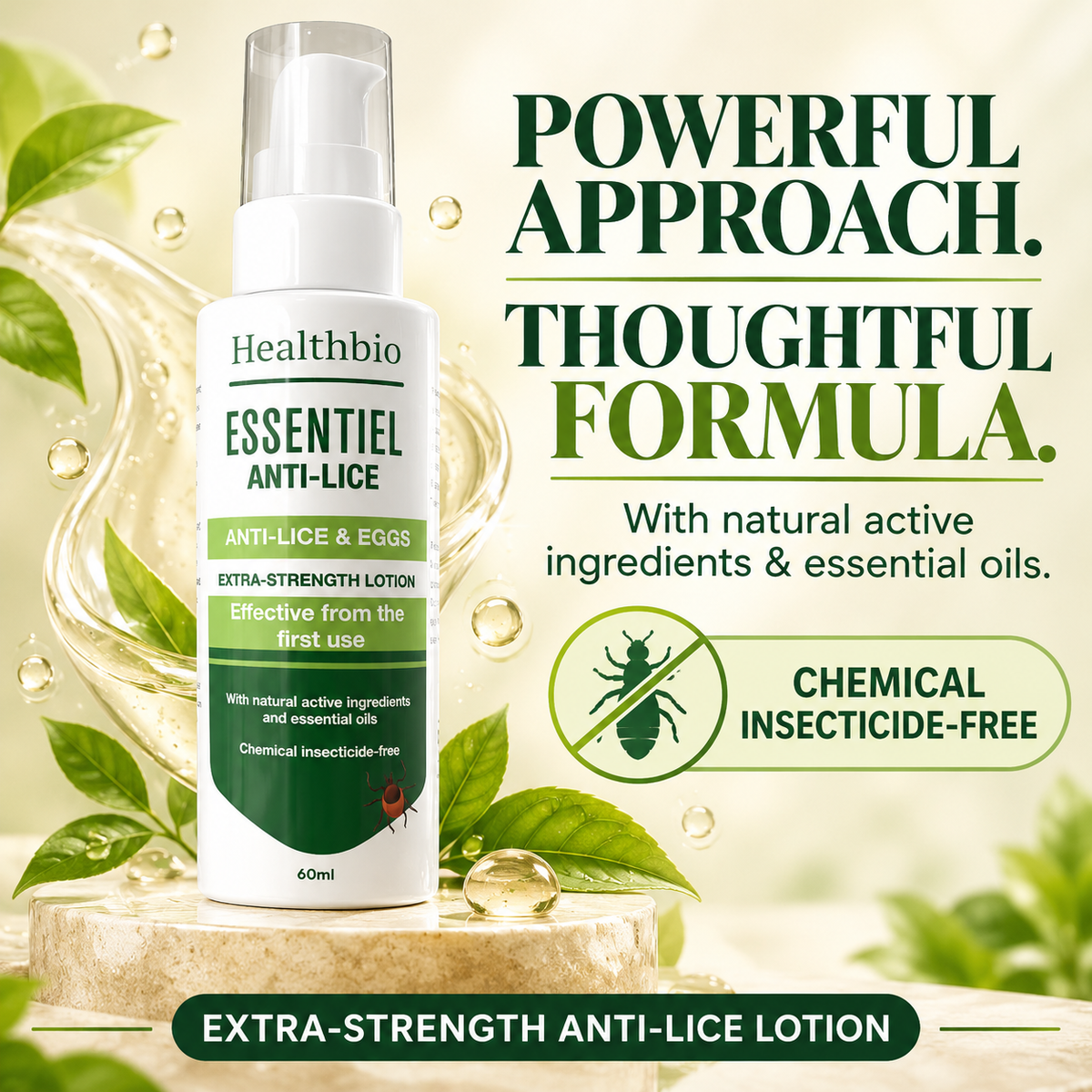
No chemical insecticides. Which also means nothing here that lice can become resistant to.
Follow the schedule on this page — both applications, with combing. If you’re still finding live lice two weeks later, tell us and we’ll refund it, bottles used.
“We treated it and they came back.”
They never left. The eggs hatched.
Live lice are dealt with. The head looks clear, everybody relaxes, and the bottle goes in the cupboard. This part usually goes fine.
Eggs are glued to the hair shaft near the scalp, inside a hard shell. No product on the market reliably gets every one of them. Some always survive.
The survivors hatch out as nymphs. Tiny, pale, almost impossible to spot. Nobody is checking by this point, because the problem looked solved a week ago.
Those nymphs reach adulthood and start laying. Two weeks after you “finished”, the itching returns and it feels like the product failed.
Breaking that cycle takes a second application between day seven and day nine. That window is the entire difference between finished and endless.
Lice can evolve resistance to a poison. They can’t evolve a defence against being smothered.
Why insecticide-free is the stronger option nowFor decades the standard approach was a chemical insecticide. Lice have had decades to adapt to it — and across much of the world they now have. Entire populations of head lice carry mutations that blunt the old treatments, which is where the term “super lice” came from.

An insecticide-free lotion works by covering — it spreads over the hair and scalp and coats what is on there, blocking the tiny openings lice breathe through rather than attacking their nervous system.
That distinction matters more than it sounds. A chemical has a biological target, and a target can be mutated around over generations. A physical coating has no target. There is nothing for a louse to become resistant to, this generation or the next.
Not one. The first handles what is alive today; the second catches whatever hatches from the eggs that survived it.
Late enough that the remaining eggs have hatched. Early enough that the new lice haven’t started laying. Miss the window and you restart the clock.
So resistance is not part of the conversation — and neither is the smell most people remember from childhood.
Almost every “this didn’t work” story is a missed second application. Set a reminder the same evening you do the first one — by then it will feel unnecessary, which is exactly why people skip it.
This is also the honest reason the two-bottle option is the one pre-selected. One bottle is one application, and one application is half a course.
We could leave this out and the page would convert better. But combing is the single highest-value thing you can do, and it’s the step families skip because it is tedious and because the lotion feels like it should have been enough.
Work on damp hair, in small sections, from the scalp outward. Wipe the comb on a white tissue after each pass so you can actually see what’s coming out. Do it again a couple of days later. It’s dull, and it’s the difference.

Including the one we’d send you to a pharmacist for, and the one your mother swears by that we’d gently talk you out of.
| Essentiel insecticide-free |
Chemical insecticide |
Prescription treatment |
Oil or mayonnaise home remedy |
|
|---|---|---|---|---|
| Affected by lice resistance | No | Yes, widely | Less so | No |
| Acts on live lice from the first use | Yes | If not resistant | Yes | Unreliable |
| Still needs a second application | Yes, day 7–9 | Yes | Usually | Yes |
| Still needs combing | Yes | Yes | Yes | Yes |
| Free of chemical insecticides | Yes | No | No | Yes |
| Needs a doctor’s appointment | No | No | Yes | No |
Every row in that table says “yes” to combing and a second application. That isn’t a weakness of one product — it’s how head lice work.

Work on dry hair, parted into sections you can actually see down to the scalp. Rushing this is why patches get missed.

Roots first, then along the lengths to the ends. Every strand needs to be wet with it — a coating only works where it actually reaches. Leave on as directed, then rinse.

Fine-tooth comb, damp hair, small sections, scalp outward. Wipe the comb on a white tissue between passes. Then put day 7 in your phone.
Treating one person while someone else is still carrying them is the other reason this turns into a month-long saga. Check everyone, treat everyone who has them on the same day, and keep brushes and hair ties separate until you’re through. There’s no need to fumigate the house — lice do not survive long away from a scalp.
You do both applications, you comb properly, and two weeks later you’re still finding live lice. You tell us and we refund it, bottles used. At that point it’s worth seeing a pharmacist or doctor — and you’ll already have ruled out the two things that cause most failures.
Day 0, day 8, a few sessions with the comb, and it’s finished inside a fortnight. No insecticide on your child’s scalp, no chemical smell through the house, and no quiet dread every time a note comes home from school.
$25.40 each · free US shipping · discreet packaging

Two applications, seven to nine days apart, with a comb between them. No insecticide, nothing to become resistant to, and no third round in a month’s time.
Free US shipping · ships in 1–2 business days · discreet packaging
